[bars]
Common Names: Blossom-headed Parakeet, BHP
Scientific Name: Psittacula roseata
Origin: India, South East Asia.
Relative Size: 12 inches
Weight: 80-85 grams
Average Lifespan: 20-30 years
Egg Clutch: 4-5 white eggs
Incubation: 24 days
Talking Ability: Excellent
GENERAL INFORMATION ABOUT BLOSSOM-HEADED PARAKEETS
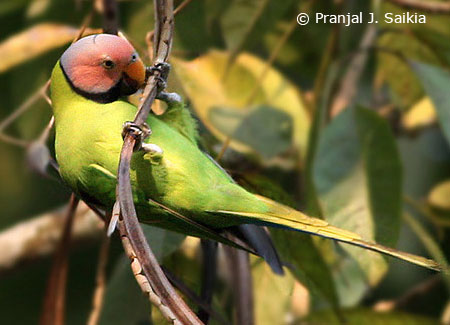
Blossom-headed Parakeets look very similar to their cousins the Plum-headed Parakeet. These birds look so similar that often the two are mistaken for the same species. Blossom-headed Parakeets have pink heads while their cousins the Plum-headed Parakeets have a purple and pink head. The body feathers of the Blossom-headed Parakeet are lime green with the wings showcasing a richer green mixed with aqua blue. On the wings are maroon colored patches that resemble those of their larger cousins the Alexandrines. Their tails are long and black; however, unlike the Plum-headed Parakeets the tips are yellow rather than white.
[ads]
Their beaks are comprised of two colors, orange and black. Like most Asiatic parrots, these birds are sexually dimorphic which means males and females can be sexed by visually looking at their feather colors. The males will develop a dark black ring while the females will not. All juveniles and females will have light purple caps on their head. Only when the male bird matures will it get its full color. The eyes are yellow and black. These parrots are almost identical in size to the cockatiel bird.
Most birds will start to realize their full color within a year and half after hatching, but it can take up to three years.
Different mutations of these birds are not very popular and they are hardly sold as pets. The mutations that are available are usually bred in exclusive aviaries and kept out of the pet trade. Currently, private breeders have established mutations such as cinnamons, opalines, and pieds. Those may begin making it into the pet arena shortly.
Many breeders go to great lengths to ensure they do not mix the Blossom-headed and Plum-head Parakeet bloodlines as they try to preserve this particular species.
BLOSSOM-HEAD PARAKEETS IN THE WILD
These birds thrive in the woodlands and forests and are perfectly at home being on the ground foraging for food. These birds are experts at finding fruit and seeds in their environment. They can often be seen hanging upside down or resting on buildings throughout the day. These birds are not endangered; however, loss of habitat has forced these birds to move towards urban areas.
Their diet consists of seeds, fruits, and blossoms. Feeding stations by locals have allowed these parrots to thrive and many birds know where to find these established stations. Many tourists will also drop bread crumbs just to watch these birds gather and eat and this has also helped to sustain these birds.
During the breeding season, these birds will branch off into pairs and find a tree nesting cavity. The female will tailor the nesting place to her liking before any eggs are laid. The male does not help to prepare the nest. Instead, he watches for intruders and feeds the hen while she is incubating her clutch of eggs.
BLOSSOM-HEADED PARAKEETS IN CAPTIVITY
These birds were never really popular in captivity. After outlawing the import of parrots, their populations soon came to a standstill. It was only through exclusive breeders who specialized in Asiatic birds that allowed these birds to enter the pet market. To offshoot the smaller numbers of these birds in captivity, many breeders used the much more common Plum-headed Parakeet females to breed with the Blossom-headed Parakeet males. This breeding produced much larger parrots with additional vibrant colors.
For this reason, many breeders who hold fast to the true bloodlines of these birds are trying to ensure they only breed with pure Blossom-headed Parakeets. As mentioned before, these birds are not popular in the pet trade but are well established and more admired as aviary ornaments.
It should be noted that their cousins the Plum-headed Parakeet is much more in demand as their colors are very vibrant.
BLOSSOM-HEADED PARAKEETS AS PETS
Blossom-headed Parakeets make wonderful pets. These parrots are very curious by nature and enjoy being petted and thrive on interaction with humans. Like most Asiatic birds, they are not cuddly but this does not mean they don’t enjoy watching television with their owners or being carried on their owner’s shoulders.
These birds are best purchased after weaning and after being hand fed. Their lifetime personalities are developed through constant handling and early socialization. The owner should only react to desired behavior and ignore any behavior that is not wanted. These birds are very smart and have enormous parrot personalities.
Because these parrots fall into the Asiatic parrot group, they are gifted when it comes to talking. Most start talking around five months but some will start around one year. Just before talking the parrot will go through a babbling stage. This stage should be encouraged and the bird should be praised every time it tries to talk. Eventually, the bird will start to speak and it is the owner’s role to continually practice words with the bird to enhance the parrot’s vocabulary. These birds love hearing their owners talk in loud exciting voices. The males tend to be better talkers then the females.
It should be said that buying a parrot just for its talking ability is not a wise choice as some birds never develop this skill.
BREEDING YOUR BLOSSOM-HEADED PARAKEET
These birds are easily bred if the conditions are right. They need a larger cage then most species of parrots due to their size. They also do best in aviary settings. If these birds are bred in a breeding cage, best results are attained if the cage is suspended so that the birds are given privacy from watchful eyes.
The breeding season varies from location to location, but if a person is observant the parrots will begin to give clues that this phase has started. The males and females will become more affectionate by preening and feeding each other. The female will also spend a great deal of time inside her nesting box preparing it for her eggs. Most breeders keep a layer of wood shavings at the bottom of the nesting box; however, the female might begin to remove it. If this happens, a small handful of wood shavings should be placed back into the nesting box to ensure the eggs don’t roll and break.
After mating, the female will lay between four and five white eggs; one egg every other day. The female usually starts sitting around the second or third egg. Once incubation starts, the female will incubate for approximately 24 days.
Once the babies hatch, the breeder can expect them to fledge (leave the nest) around seven to eight weeks. After leaving the nesting box, the mother will encourage her babies to eat on their own and most will be weaned by 9-10 weeks.
HAND FEEDING
Should an emergency arise, or the breeder wishes to hand feed the babies for pets, the chicks are best pulled when the oldest chick is at least 15 days old. All the babies will then need to be pulled for feeding as the mother will most likely abandon her nest once she discovers a chick is missing.
These birds are usually fed with a hand fed commercial formula such as Kaytee Exact. It’s important the breeder let the mother’s food digest inside the chick’s crop before a commercial formula is used as this can cause an upset stomach or sour crop to the bird. If this should happen, immediately phone a veterinarian for help.
The babies will grow rapidly and develop feathers quite quickly. Once the babies are ready to wean, the breeder should include an assortment of fresh fruits, vegetables, pellets and seeds into the parrot’s diet. These birds can become picky if they are not exposed to different foods at a young age. Exposure to this assortment of foods is important for a healthy bird.
When the birds start the weaning process, most will start to refuse any feedings. This is normal and the breeder should then feed the birds more frequently throughout the day rather than only feeding them once in the morning and once at night. Most babies at this stage will only take small amounts; this is normal. Birds that are fed more frequently will wean faster as they don’t spend their time begging for food.
Using warm pumpkin, squash, carrots, or fruit mashes are perfect to help them convert to solid foods.
Once the babies are weaned, they can then be sold and placed into an aviary.
CAGING AND HOUSING YOUR BLOSSOM-HEADED PARAKEET
The cage of the parrot needs to be large enough to ensure the parrot can turn around, flap his wings, and swing from his toys without hitting the cage bars. These parrots are very active and need enough room to climb around.
Blossom-headed parrots are also wonderful escape artists; therefore, locks should be added to cages to ensure they do not escape and get into trouble.
The perch and toys need to be suspended away from food and water bowls as they can quickly contaminate the bird’s food and drinking area.
Most importantly, the cage should also have a grill so the parrot cannot touch its droppings or any of the contaminated food that has spilled. The grill should be easy to slide out for daily cleaning.
The bars of the cage should be no larger than one-half inch apart to ensure the parrot doesn’t stick his head through the bars and gets hurt.
FEEDING YOUR BLOSSOM-HEADED PARROT
When feeding your parrot, it’s important it is given a variety of fruits, vegetables, seeds, and pellets. An owner should ensure that these items are placed high off the floor of the cage.
These birds tend to be finicky when trying new foods if they are not exposed to it as babies. If the owner finds this is the case, new foods should be added daily as curiosity will eventually get the best of the bird
and it will then try the new food. Never should a new food item be switched for the main food without giving the parrots enough time to adjust; many Blossom-headed Parakeets will starve to death if this happens. .
Foods that should never be given to birds are avocado, chocolate, and alcohol.
If you feed your parrot well, you can expect it to live between 20-30 years.
[ads]