[bars]
Common Names: Indian Ringneck, Rose-Ringed Parakeet, IRN, Ringneck Parakeet
Scientific Name: Psittacula krameri
Origin: Asia, India, & Pakistan
Relative Size: 16 inches
Weight: 120-125 grams
Average Lifespan: 15-30 years
Egg Clutch: 3-6 white eggs
Incubation: 23 days
Talking Ability: Excellent
GENERAL INFORMATION ABOUT INDIAN RINGNECK PARROTS
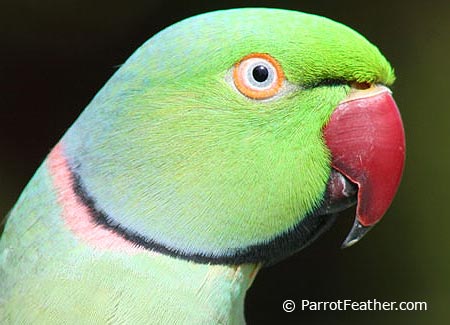
The normal green Indian Ringneck has a lime green body and blue tail. Hints of a turquoise sheen can be seen on the bird during overcast days. When the bird is in full flight, the wings and tail feathers will showcase a bright yellow that is only visible underneath the parrot when in flight. Their beaks are cherry red and mature ringnecks will have yellow and black eyes.
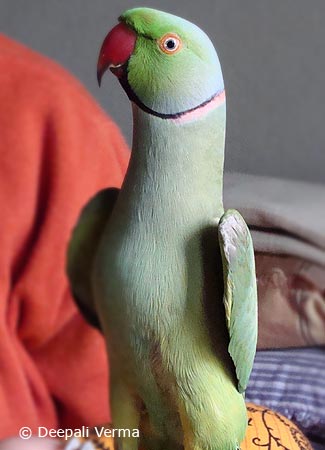
These birds are sexually dimorphic, which means the birds can visibly be sexed by reviewing their colored feathers. The males develop a black ring between 18 months and by three years the ring is highlighted with pink and blue. The females do not have the ring; however, they do show a lighter green ring that can be seen upon closer inspection.
[ads]
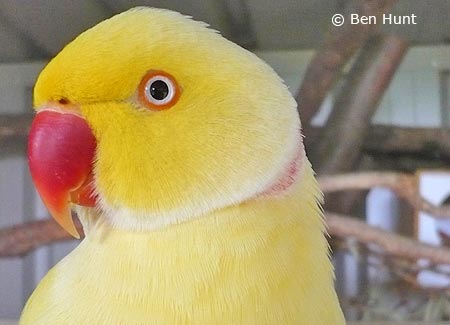
The normal green Indian Ringneck today has been bred to encompass many mutations. These birds can be purchased in solid colors such as blue, yellow, white, or gray. Along with these solid colors, there are many other mutations such as cobolts, clear tails, pieds, cinnamons, and lacewings just to name a few.
Yearly new mutations are constantly being discovered. Various mutations created are established only after careful breeding and certification. Newly developed mutations are often expensive because they are new and rare, but eventually drop in price once the mutation has been established and the market becomes saturated. For this reason, many mutations are now sold as handfed babies to create demand.
There are so many Indian Ringneck mutations available today that they easily rival the budgie and lovebird when it comes to variety. Most new Indian Ringneck owners will not have a problem finding a color they like.
The average size of these parrots is about 16 inches in length, similar to the size of a conure or cockatiel bird. The tail makes up for a large portion of the bird.
WILD INDIAN RINGNECKS
Indian Ringneck parrots natively reside in Asia—mainly India and Pakistan. They are forest dwelling animals that will occasionally forage for food on the ground. Due to deforestation, these birds have moved to larger cities where they survive from bird feeders and food offered by the native people.
These birds are known to be sentinels (watchmen) and will quickly make it known when danger is present as they make loud calls. These birds will flock together in the hundreds and branch off to find a nesting cavity during breeding season. The nest cavities usually consist of damaged holes in buildings or holes in trees.
In the wild they feed on seeds, fruit, and blossoms. During the spring and summer it is not uncommon to see them moving from tree to tree looking for blossoms or ripe fruit.
Though these birds are native to Asia, they have managed to establish healthy populations in Britain, the Middle East, and the United States. They are known for their adaptation skills and are difficult to spot due to their green coloring. They have become such a spectacle in urban areas that many people encourage these parrots by continually feeding them with tasty morsels of food.
INDIAN RINGNECKS & FARMING
Many farmers have clearly expressed their dislike for this particular parrot specie because they sometimes feed from their crops and create damage. These farmers will go to great lengths to ensure these birds will not ruin their harvest. Some farmers even resort to shooting these birds while others will trap them.
INDIAN RINGNECKS IN CAPTIVITY
Ringnecks have been kept in captivity for hundreds of years and have always been popular pets in Asia, particularly Pakistan and India. Once these exotic parrots were seen by foreigners, they were quickly exported back to their countries. Alexander the Great was fascinated by ringnecks and exported them throughout the Mediterranean area.
As our modern times have approached, these birds have become popular in the United States, Australia, the United Kingdom, and South Africa.
Unfortunately, these parrots have become so popular that many Indian Ringneck owners irresponsibly release these parrots into the wild believing it is the best remedy for the bird. This is detrimental to the bird, ringneck owners, agricultural establishments, and native bird species competing for nesting space. If the ringneck is no longer wanted, it should be re-homed or placed into an aviary. As a result of careless behavior, these birds are now illegal to own in New Jersey.
INDIAN RINGNECK AS PETS
Indian Ringnecks are not typical parrots, nor are they suited for first time bird owners. They are best left for owners who have a bit more experience with parrots in general.
If they are purchased as a handfed baby, they will make remarkable pets and if an owner continues to work with the birds they will provide great joy.
These birds enjoy being petted in the direction that their feathers grow and will gladly sit on their owner’s shoulders throughout the day. They are extremely smart creatures and demand to be challenged mentally by the owner and their environment. Teaching them tricks, playing games, and giving them complex toys is highly recommended.
These birds are not too cuddly but make up for this in many ways. They need to be with their owners and will bond quite strongly. Females tend to form stronger bonds, while the males are a bit more relaxed. From an early age, all family members should partake in handling the bird to avoid jealousy issues.
This particular Asiatic parrot is the most aggressive of their species. For this reason, positive reinforcement and gentile dominance should be practiced while the bird is still a baby. Any biting, yelling, or unwanted behavior should completely be ignored.
Not only do these birds make wonderful pets, these birds are gifted when it comes to talking. Quite simply, no other smaller parrot can talk as clearly as an Indian Ringneck. Both males and females talk; however, the males seem to talk more. Most start talking around eight months to one year. Before talking is mastered, the parrot will go through a babbling stage. During this stage, the owner should reward the bird and praise it for talking. With some owner effort, these birds can pick up large vocabularies and will gladly talk for strangers when excited.
It should be said that buying a parrot for its talking ability is not recommend as many will disappoint their owners. Each bird has its own personality and some will show more interest in talking while others do not. These birds should be bought for their smart and challenging demeanor, and their talking ability should be seen as an extra perk.
INDIAN RINGNECK BLUFFING
Some ringnecks go through a stage called bluffing. This simply means the parrot starts to get a bit aggressive after weaning. Usually this behavior happens suddenly and can last a few weeks or months. During this time, the owner should handle the bird with confidence and completely ignore any aggressive behavior. The ringneck owner should not place the bird on their shoulders during this time as facial bites will occur. It is important to note that the degree of bluffing depends on the birds and it is nothing but a phase. As quickly as this aggressive behavior appears, it will quickly dissipate.
The owner should not tell the bird to stop biting, yell at it or giving it eye contact. It is best to simply ignore the behavior. Should the bird go beyond the bluff and bite stage, the owner should simply move their hand back and continue working with the bird while ignoring bad behavior.
Yelling, shaking, or spraying the bird with water is not a good remedy as this only develops a mean and frightened bird. Indian Ringnecks do not understand this type of punishment. Resorting to those cruel tactics will only result in the bird becoming fearful of all humans and this could lead to excessive biting.
It important to note this bluffing stage is a trait that helps young Indian Ringnecks compete for food once they are independent juveniles. Most adult ringnecks will avoid any confrontation with a bluffing juvenile that appear hyper-aggressive and mean.
BREEDING INDIAN RINGNECKS
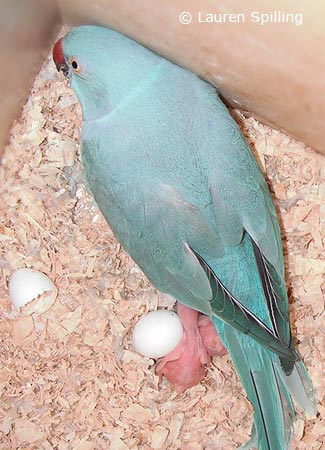
Breeding Indian Ringnecks is not difficult, but does require the birds have some privacy. Ringnecks can breed once a year and will not breed year round like some parrot species. These birds prefer to breed during the spring and molt during the hotter seasons.
These birds are often housed in large aviaries and separated in pairs during the breeding season. These birds cannot be housed together as the female is very aggressive and will kill any intruders that enter her territory.
When breeding season approaches, place a deep nesting box inside the aviary. Once the female is ready to start breeding, she will spend countless hours inside her box scratching around for materials to build their nest. Most breeders place wood shavings in the bottom of the nesting box before the breeding season begins. Many females will remove this layer of shaving, but if this should happen, the breeder should simply refill the nesting box.
Ringnecks become very affectionate when in breeding mode. Usually, most Indian Ringnecks avoid affectionate behavior when placed with other birds, but when breeding, they start to preen and feed each other. When this behavior is observed, eggs can be expected about two weeks later.
Female ringnecks lay between three and six white eggs; one egg every other day. The female will start incubating the eggs as soon as the second or third egg is laid. The incubation period lasts 23 days, and the chicks will make a small hole from inside the eggs before they hatching. Once hatched, the babies will stay with the mother until they are at least 10 weeks old or weaned.
If the owner wishes to hand feed the babies, they should be pulled when the oldest chick is about 15 days old.
When weaning baby ringnecks, the owner can expect their babies to wean around 10-14 weeks. Ringnecks that are kept alone take much longer to wean than if kept with their parents. This is normal and the breeder should never starve the bird to encourage weaning. In fact, feeding more throughout the day as the bird matures stimulates the bird to eat solid foods instead of begging for food all day.
SOCIALIZING AN INDIAN RINGNECK
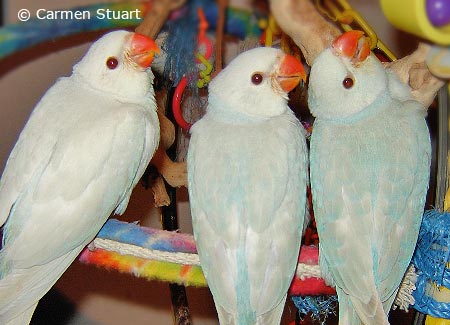
Baby Indian Ringnecks require a great deal of socialization during their younger years. How the owner treats and interacts with the bird will define how the bird acts throughout its life. While still a chick, owners should pet the babies constantly, talk to them and feed them a variety of foods.
As the chick matures he should be allowed to fly before the wings are clipped. The bird should be able to master maneuvering up and down and hovering. Once the bird has mastered this, the wings can safely be clipped.
SELECTING THE RIGHT CAGE FOR AN INDIAN RINGNECK
The cage for the bird needs to be large as Indian Ringnecks have large tails. The bird should be able to climb around without damaging their tails. It should also be large enough for the bird to turn around, flap its wings, and hop form perch to perch.
A grill should be installed on the bottom of the cage to ensure the parrot doesn’t access its waste or spoiled food. The bottom of the cage should be lined with paper and cleaned daily.
The gaps between the cage bars should be small enough that the ringneck cannot stick his head through it. If the bars are spaced too far apart the bird might easily escape or get its head stuck. A powder coated cage is ideal as this does not rust and won’t cause metal poisoning and can easily be wiped. Locks on the doors should be installed on the cage because Indian Ringnecks are wonderful escape artists.
FEEDING YOUR INDIAN RINGNECK
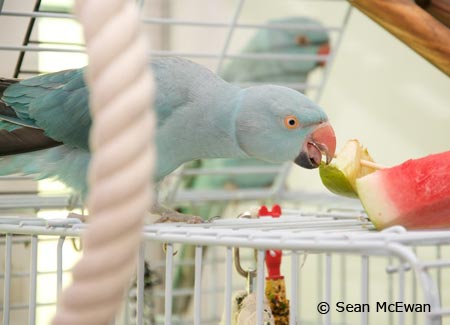
Indian Ringnecks are not picky eaters. In fact, almost anything placed into the cage will quickly be devoured. Fresh fruits and vegetables should be placed daily into the cage. It is important these foods be washed and cleaned to avoid pesticides.
A base diet of seeds and pellets should be given to the parrot as well. Using a mixture of conure seed or cockatiel seed will do just fine.
It not a good idea to mix pellets and seeds together as ringnecks will almost often leave the pellets. Instead, they should be rotated weekly to ensure they receive adequate nutrition.
If the ringneck does not eat pellets when introduced, the owner should place them into the cage daily with the seeds to allow time for the parrot to adjust to this new food. Eventually the Indian Ringneck will eat them. Consistency is the key.
If your ringneck is well fed and taken care of, you can expect him to live between 15 to 30 years.
If the ringneck does not eat pellets when introduced, the owner should place them into the cage daily with the seeds to allow time for the parrot to adjust to this new food. Eventually the Indian Ringneck will eat them. Consistency is the key.
If your ringneck is well fed and taken care of, you can expect him to live between 15 to 30 years.
[ads]