[bars]
Common Names: Moustached Parakeets, Mustached Parakeets, Red-breasted Parakeet
Scientific Name: Psittacula alexandri
Origin: Indonesia, Andaman Islands, Southeast Asia
Relative Size: 13 inches
Weight: 120-130 grams
Average Lifespan: 20-30 years
Egg Clutch: 2-4 white eggs
Incubation: 22 days
Talking Ability: Excellent
GENERAL INFORMATION ABOUT MOUSTACHED PARAKEETS
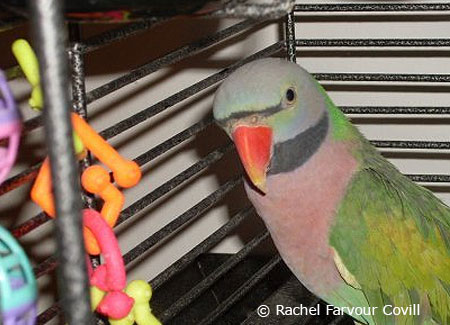
Moustached Parakeets look very similar to their cousins, the Derbyan Parakeets. The most obvious differences are the sizes. Like the Derbyan Parakeet, the Mustache Parakeet is sexually dimorphic. This simply means the males and females can be identified by how they look. The males have a bright colored beak tipped in yellow and the females have a black beak.
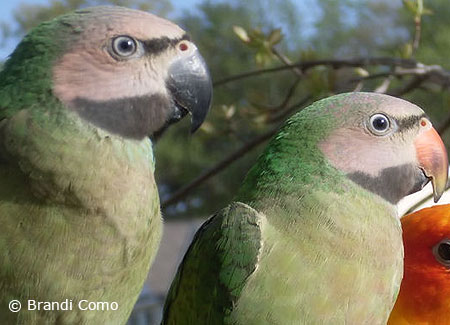
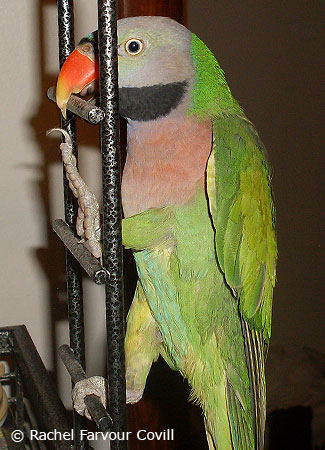
These parrots have green bodies showcasing many shades of green. Their most obvious trait is their salmon-colored chest. The male’s chest usually tends to be a brighter colored pink than the females; nonetheless, she is just as stunning as her mate. Under their beaks and extended along the jaw line, a black bib can be seen. Both sexes have a grayish blue cap, and like most Asiatic parrots a black line extends from the nostrils to the eyes. The wings have yellow patches intermixed with lime green.
[ads]
These parrots do not have the typical large tail. Instead, their tails extend about 5 inches from the body. The tail and body are approximately about the same length; although, the younger Moustached Parakeets do have smaller tails.
All juvenile Moustached Parakeets resemble their parents but are not so colorful. These young parrots exhibit a gray head and a solid green body with orange beaks. Their eyes are also black but soon change as the bird matures. Most owners will start to see a change in five months and usually by eight months the eyes have changed into adult form. Their beaks will also change color as the parrot matures. This change is usually seen between five and eight months. It can take up to 18 months or even up to three years for the parrot to come into full color.
MOUSTACHED PARAKEETS IN THE WILD
Moustached Parakeets can be seen in the wild in large flocks ranging between 20 to 60 birds. These parrots do not usually mingle with other parrot species but have done so on occasion. These parrots are loud when together in flocks and can often be heard long before their arrival. Like most Asiatic parrots, these birds are sentinels and will make a loud call when danger is near.
These birds thrive in woodlands, hilly areas, and mountains. Unfortunately, due to habitat destruction these birds have managed to survive in urban areas. They can be seen feeding from stations or eating bread crumbs left behind by people. In the wild they feed on seeds, blossoms, and fruit.
When breeding season approaches, around April, these birds will pair off and look for a nesting hollow cavity to raise their young. The female will find an old hole inside a tree and will modify it to her liking before she lays her eggs. The male stands guard and feeds the female while she is incubating.
If babies are successfully raised, they leave the nest around seven to eight weeks.
MOUSTACHED PARAKEETS IN CAPTIVITY
These parrots can be found in captivity but they are not as popular as their cousins, the Indian Ringneck and Alexandrine. These birds are most often found by collectors specializing in Asiatic parrots or by breeders scattered throughout the United States and Europe in bird clubs.
Sadly, these parrots are not seen as pets but rather seen as aviary ornaments. There are only a few mutations available for these birds. Those that exist are usually in blue, turquoise, or fallows.
MOUSTACHED PARAKEETS AS PETS
These birds are often referred to as the best kept secrets of the parrot world. They have sweet personalities and make wonderful pets. It is best to purchase a young Mustache Parakeet and it should be weaned before bringing home.
These colorful parrots are very active and love to explore their environment. For this reason, they should be given lots of toys to stimulate them throughout the day. Though these parrots are on the smaller side, they enjoy toys made from leather, wood, and beads.
It’s important the owner know these birds are not very cuddly; however, there are exceptions to every rule. Being stroked in the direction that their feathers grow seems to be enjoyed, especially around the neck area. The more these parrots are handled and touched, the more they appear to enjoy it.
Most owners enjoy having these birds perched on their shoulders. Moustached Parakeets are curious by nature. They will always try to climb down and investigate anything their owners are doing such as reading, cooking, or household work.
Like most Asiatic parrots, these parrots are gifted at talking. The males seem to be more gifted than the females but both can learn to talk. It’s important that these parrots not be purchased solely on their reputation for being great talkers because not all birds will learn to talk and then the owner may be disappointed.
Respectively speaking, Asiatic parrots are quieter in general when it comes to parrots. For this reason, a pet Mustache Parakeet might go unnoticed in a townhouse or apartment. However, these birds can be expected to make contact calls every morning, noon, and night. If the parrot is a talker, most will substitute a great deal of their contact calls with talking which is advantageous to the owner and others.
A play stand should be used to keep the parrot close to you when possible. This can serve as a temporary substitute to keep the bird close to you and give it some kind of attention. The stand should be made of wood, easy to clean, and be located where the owner can keep a watchful eye on the parrot. If the parrot decides to leave the stand, the owner needs to put the parrot back on the stand until it becomes a habit for the bird. This might take a few tries before the bird understands to remain perched on the stand. The key is to be consistent and reward the bird when it is acting as it should.
BREEDING MOUSTACHED PARAKEETS
Unlike the Derbyan Parakeet (seems to be a bit more difficult to breed), Mustached Parakeets breed as readily as Indian Ringnecks. Most start to breed in spring just before the hotter months. Though breeding times will vary depending on location, you can almost always tell that it’s time because the female will begin to sing before she lays her eggs.
A female Mustache Parakeet hen will spend a great deal of time inside her nesting box before she is ready to breed. During this time, the owner might hear scratching and chewing inside the box. This is quite normal. Often times, the nesting material that is placed into the box (wood shavings) will be removed by the hen. The owner simply needs to replace the wood shavings back into the box to ensure the eggs do not break or roll during incubation.
Moustached Parakeets like deeper boxes. A ladder or wire should be placed from the hole down into the nesting area to ensure the female does not crush her eggs upon entry. A side door is best as this allows easy access to the babies or eggs once they are laid.
The mother will produce between two and four eggs. She will incubate them for approximately 22 days. Just before the babies hatch, a small hole will be made from inside the egg by the chick so that it can breathe. Hatching usually follows within 24 hours.
If the babies are to be pulled for hand feeding, the owner should wait until the oldest chick in the clutch is 15 days old. Once one chick is removed, it’s best to also remove the others as sometimes the mother will abandon her brood if one chick is missing.
Hand feeding the chicks is a tedious task and requires the breeder to feed them hourly. Once the baby Mustache Parakeet is ready to wean, it will start to refuse feedings or will begin to take smaller amounts of food. This is normal and the breeder can expect the chick to lose a bit of weight. The breeder should then begin feeding the baby chicks small portions many times throughout the day rather than two or three large feedings as previously done. In fact, breeders who practice small frequent feedings tend to wean the chicks faster. Most baby Moustached Parakeets will wean around 10 weeks but some can take as long as 13 weeks—especially if the baby is by itself.
SELECTING A CAGE FOR YOU MOUSTACHED PARAKEET
These parrots require a cage as large as your budget can afford. They are active creatures that will benefit from having a large cage. As a rule of thumb, the cage should be big enough to ensure the parrot can turn around, flap his wings, and swing from side to side without touching the cage bars.
Accessories such as toys and perches should be rotated inside the cage on a weekly basis to help minimize territorial behavior. All food bowls and toys should be placed away from perches to ensure they do not get contaminated with droppings.
Powder coated cages work best for this specie as they are easy to wipe down and clean when the parrot makes a mess. The bar spacing should be no less than a half inch apart to ensure the parrot cannot squeeze through or get its head caught between the bars.
If the cage has doors that can easily be opened, it is recommended that locks be purchased or the door be latched as these parrots are magnificent escape artists.
The bottom of the cage should have a grill installed to ensure the parrot does not have access to spilt food or its droppings. A slide out tray is also needed as this allows the cage to be cleaned with ease.
FEEDING YOUR MOUSTACHED PARAKEET
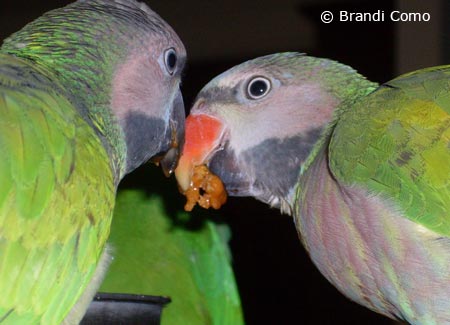
Moustached Parakeets are omnivores and can eat anything humans can. Their basic diet should consist of seeds and pellets. It’s important both food items be rotated weekly to ensure the parrot receives the maximum amount of nutrients. It’s not recommended to feed the parrot just a seed diet or just a pellet diet as too much of anything is not good for the bird.
Along with the base diet, the parrot should be given a daily assortment of fresh vegetables and fruits. These food items can easily be cut up the night
before while preparing dinner. Moustached Parakeets also enjoy warm foods. Steaming fresh broccoli, carrots, or squash will quickly be relished—just be sure the food is not too hot as it can burn the parrot.
If a Mustache Parakeet is fed an assortment of foods, the bird should have minimal problems and can live between 20 to 30 years.
[ads]