[bars]
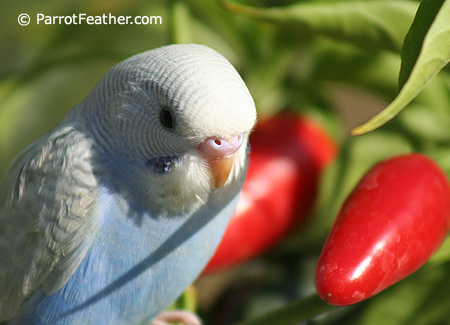
Feeding a Budgerigar is a lot like feeding a human. As a responsible owner it is important to provide a healthy diet to ensure that your bird remains happy and healthy. Some owners go the extreme and prepare gourmet type meals for their pets because they truly enjoy spoiling their pet Budgies (Budgerigar). Feeding a Budgie a proper is not difficult and optimal health can be achieved once it is understood what the Budgie needs to remain healthy.
A Base Diet for a Budgerigar
Budgies in general should be given a base diet of seeds. A good seed mix will contain Canary Seeds, Millet, Linseed, Niger, Rape, and Groat. The owner should ensure the seeds are fresh and sealed before giving them to their pet Budgies. Old seeds will lose their oils and nutrients over time. For this reason, seeds should never be bought in large quantities unless there are a lot of Budgies present. If a lot of seed has been purchased for one bird, the owner can place the seed inside a refrigerator as this will help maintain nutritional value for longer periods of time. If the seeds contain any moths, have lost their luster, or do not smell like fresh grain; they should be discarded.
[ads]
Pellets should also be given to a Budgie in addition to seeds. Pellets have many benefits and a lot of nutrients that are not found in seeds. It is important the pellets be rotated with the seeds throughout the week as most Budgies will avoid the pellets if seeds are included within the mix. The pellets should be small as Budgies have smaller beaks.
It is also important the pellets be gradually introduced into the Budgies diet before being rotated with the seeds. Most Budgies will starve to death if they have not been given a chance to convert to pellets. See our section about converting your Budgie from seeds to pellets.
Along with a base diet of seeds and pellets, vegetables are also essential for a Budgie’s health. Freshly grated carrot, broccoli, or zucchini can be given daily. Additionally, greens such as dandelion leaves, spinach, kale, and carrot tops also provide excellent sources of calcium and iron. Fresh brightly colored peppers are also highly enjoyed as the bright colors will peak a Budgie’s curiosity. The more colorful the peppers, the more antioxidants it contains and the healthier the Budgie will be. Vegetables should be given daily as they provide the Budgie with the extra minerals and vitamins.
Fruits are also enjoyed by Budgies too. Fruits should be given periodically throughout the week as they too offer essential minerals and vitamins. Apples, pears, oranges, kiwis, mangoes, or grapes can be provided daily. It is important that all perishable items be removed within a few hours as they can quickly spoil.
Cooking For Your Pet Budgie
Budgies also enjoy cooked foods as well. A favorite of many Budgies is a mixture of lentils and brown rice. Some owners will create a salsa comprised of tomatoes, peppers, and diced mango and then incorporate this mix with brown rice. On occasion, a Budgie should also be given proteins such as cooked chicken, turkey, or lean beef. This provides them with extra protein and keeps their muscle and feathers healthy.
Some Budgies have become so accustomed to cooked food that they may even enjoy warm foods as well. It all depends on the exposure of the Budgie. It is important the owner ensure the food is never too hot and therefore should always be tested it to ensure that it does not burn their bird. A good rule of thumb to remember—if the food is too hot for an owner to eat it is also too hot for a pet Budgie.
When cooked foods are given, the owner should avoid using foods with preservatives and salt. These ingredients are not good for the bird.
Preparing Budgie Food
Preparing a pet Budgie’s food is not difficult if planned ahead of time. Many owners can cut the food into smaller chunks and store them in the refrigerator throughout the week while preparing their own meals. This helps to ensure the owner always has healthy food on hand. This is especially important as many owners often become busy with work and the result is a poor diet for the bird.
Because Budgies cannot manipulate their food with one hand like their larger parrot cousins, a Budgie owner should take the time to cut the food into tiny pieces. This allows the bird to eat the food easily. Budgies enjoy food that is shredded, cubed, or sliced.
Toxic Food to A Budgie
A pet Budgie should never be given avocado, chocolate, or any alcoholic beverages. These items are poisonous or may cause allergies. If the bird has ingested any of these harmful foods, immediate action should be taken and the bird should be seen by a veterinarian.
Variety Is the Key to a Healthy Life
Ever heard the saying, “Too much of anything is a bad thing?” This statement holds true for Budgies as well. These birds thrive on a diet that is varied and rotated weekly. If a Budgie is fed right it will live a long life and will entertain its owner for many years. A Budgie that is healthy can live between 10 and 15 years if fed properly.
[ads]