
Raising a Tame Lovebird: Guidelines And Rules
Teaching your lovebird rules to live by is important for both the owner and the bird. These tiny parrots may be small but they do require guidelines to ensure they don't become nippy or loud. Just like their larger cousins these birds develop the same behavioral problems if not dealt with.
The two problematic issues seem to be biting and screaming. Biting
can be reinforced just after weaning if careful attention and proper
techniques are not used from day one. When lovebirds go through a
“teething” stage they often nibble with their beaks. Some owners don’t
know that this stage is a testing phase much like the “terrible twos” in
children. This is totally natural and how this situation is handled will
make all the difference in the lovebird’s personality.
Screaming in lovebirds is not normal. A screaming lovebird is usually
the result of not being able to play independently. For this reason, all
owners should have a play stand with lots of toys to occupy the parrot
while away. Once the bird is content and playing alone, the owner should
praise the lovebird and let him resume his actions. The time periods can
be increased and the lovebird will learn to enjoy playing with his toys
or staying on top of his play stand.
It should also be said that screaming cannot be completely stopped as it
is unnatural. Lovebirds were designed to be vocal and owners can expect
them to chirp during the morning, noon, and before sunset. During the
day a lovebird will also sing a song of tiny chips and whistles. Keeping
a quieter environment seems to help keep the lovebirds more calm.
Avoid Lovebird Nibbling And Biting
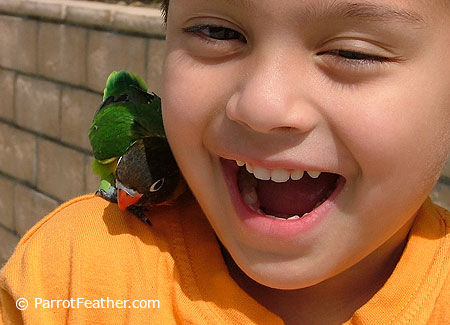
Many owners find this nibbling cute, but what they don’t understand
is that it can lead to frequent biting. During this state, the lovebird
should be forbidden to nibble on ears, fingers, or any other human part.
Not allowing this will stop any mixed messages and the bird will learn
biting is not acceptable.
So how do you let your bird know that biting is not acceptable? Simply
move your hand back and ignore the biting. Do not ever flick, shake, or
hit the bird. You should also never yell at your bird or spray him with
water. These forms of punishment are abusive and considered negative
reinforcement. It will make your bird fear you, and more likely to try
and bite and scream at you. The goal is to teach your bird to behave so
you both can enjoy each other’s company. You can tell the bird “No” a
million times and he’ll still never fully understand the meaning. If you
yell for every reaction, then you are continually strengthening the
bird’s bad behavior, whether it be biting or screaming. From the
lovebird’s perspective, you are giving him a “drama reward.” This means
that biting/screaming is only being done to get you to show attention or
to react to them. Remember, the lovebird cannot understand us and we
need to show him that bad behavior will not get a response.
Distraction Is The Key
Distraction is a great tool to help detour lovebirds from biting. In
the event that your lovebird is starting to bite or nibble take a pen
and allow him to play with it; do this while you are still holding him
so it will distract him from biting you but still let you have
interaction with the bird. Our expressions and reactions are rewards for
the birds. If they are doing something you enjoy or love, reinforce it
with a happy and excited voice. This lets the bird know that this
behavior is acceptable and is something you like, ensuring that he will
continue to do it to gain your affection. Only give a positive reaction
for things you want and never for negative behavior.
Again, like the topic of socialization, setting guidelines need to be
practiced from day one.
Basic Lovebird Rules
Here are major rules that need to be implemented when you bring home your new lovebird.
Always make the lovebird step up when asked. If the lovebird chooses to not step up, try to distract him and ask him again until the task has been completed.
Do not yell at your lovebird if he is doing something wrong—igore all unwanted behavior.
Never let your lovebird climb on your shoulder unless you place him there.
Have a play pen the lovebird can spend time on. If the lovebird wonders off, place him back continually if needed. This is for his safety so he does not wonder into danger where someone may step on him or where he can get into toxic foods or chemicals.
Never just open the cage door and let the lovebird come out himself. This promotes territorial behavior. If the lovebird wants to come out, you are the one that should take him out. Reach into his cage and have him step up on your finger.
-
Keep the wings clipped. This makes the lovebird more dependent on you. This is for the bird’s safety as well.
-
Ignore all screaming. Even looking at your bird can reinforce this bad habit as well. It is important to keep in mind screaming can’t be eradicated completely but it can be minimized though good taming techniques.
We have covered some basic rules and socialization tips to help you get a good start with your lovebird. Remember to always look at solving the problem through the eyes of the bird. How the bird perceives things is extremely different then how we do.