
[bars]
Common Names: Parrotlet, Pocket Parrots
Scientific Name: Forpus
Origin: Middle & South America
Relative Size: 5 inches
Weight: 33-35 grams
Average Lifespan: 15-20 years
Egg Clutch: 4-5 white eggs
Incubation: 19 days
Talking Ability: Moderate
General Information about Pet Parrotlets
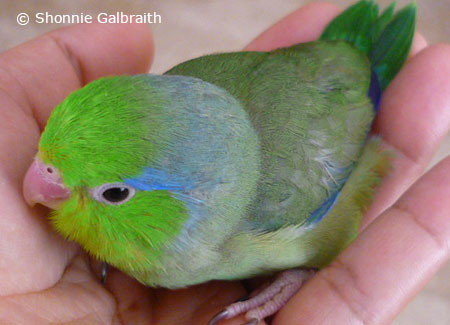
Parrotlets are tiny parrots that are about 4 ½ to 5 inches in length. These tiny birds are real parrots. In fact, many parrotlet owners often describe their birds as looking like miniature Amazon parrots. Though there are many species available in the pet industry, most parrotlets have a standard base color of green. All parrotlet species have tiny tails, a large head, a curved beak, and two toes that are pointed forward and backwards. Their beaks are beige and all species have black eyes.
[ads]
These parrots are sexually dimorphic. This simply means males and females can be easily differentiated by their colors. Male parrotlets have dark and blue wings, a splash of blue on the back, some blue on their rumps, and a blue and lime green mask. The females are dark green with blue on their faces and are just as stunning.
Though there are many parrotlet species in the wild, there are only a few kept as pets. The most common is the Pacific Parrotlet, the Mexican Parrotlet, the Spectacled Parrotlet, and the Yellow-faced Parrotlet.
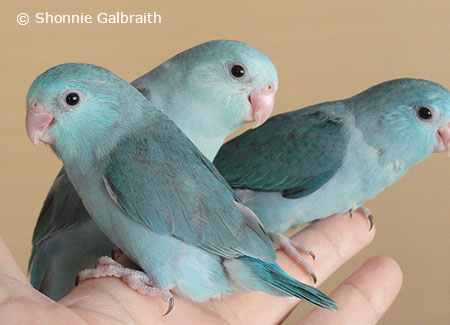
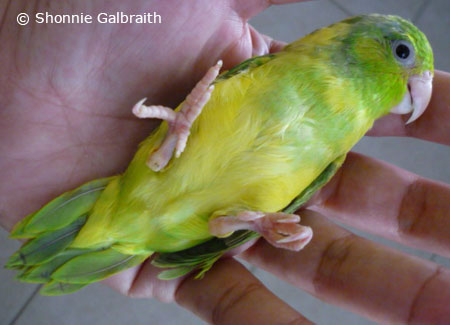
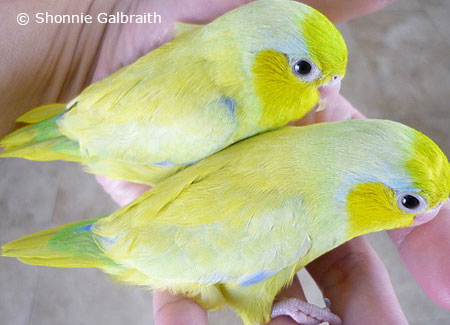
These parrots come in many colors; however, they can be quite expensive as most mutations are still new. The more common mutations available for pets are the lutinos, whites, and blues. If an owner wishes to purchase a parrot with a rare color, they will have to look for a breeder who specializes in breeding parrotlets of this type.
Parrotlets in the Wild
Parrotlets are native to South and Central America. These birds live in tropical forests and are at home in the trees. Parrotlets are seen in small flocks climbing about the trees while foraging for fruit and seed pods. When in larger flocks, these birds can be spotted at clay cliffs drinking water or removing clay from the cliff. It is believed these clay licks provide them with extra minerals and rid them of parasites and toxins. These birds can often be seen with other parrot species while drinking water. Sometimes flocks of parrotlets can become so numerous that they are often described as looking like smoke when in flight.
Once these tiny parrots enter into a breeding mode, the female will look for an empty tree cavity or termite mound to lay her eggs. Once the nesting site has been chosen, she will clean the cavity of any debris or enlarge the cavity to ensure she has enough room to raise her family. She will then incubate the eggs until they hatch while the male stands guard protecting the nest. Once the female has successfully hatched her eggs, the male and female will share the duties of feeding the babies. If food is in abundance and the babies have survived, they can be expected to leave the nest around 4 ½ to 5 weeks.
Parrotlets in Captivity
Parrotlets have not had the benefit of being in captivity for hundreds of years like other parrot species. In fact, these birds are only a few generations removed from the wild. After strict laws were implemented in the United States to stop the importation of parrots, many breeders went to great lengths to ensure these birds remained in captivity. Lots of parrotlet owners kept detailed records to ensure the parrotlets did not inbreed. Many birds were rotated to ensure genetic diversity.
Even today, some parrotlet species are so rare they are only sold to breeders who specialize in exotic birds that are exhibited in zoos or preserves.
The more common species can easily be found in bird shows or from local breeders.
Parrotlets as Pets
Parrotlets make wonderful pets if purchased at a young age or if they are handfed. These tiny parrots act very much like their larger cousins. They are very demanding, very social, and very playful creatures. Unlike larger parrots, extreme caution should be used as they are tiny and can easily be stepped on. It is important the owner teach the parrotlet to stay on its stand while the owner is not around. In the beginning, most parrotlets will wander off their stand and the owner should pick them up and place them back on. This should continue until the parrot understands he should remain there.
These parrots are very active. Most will not sit still for a moment as everything sparks their curiosity. Bright colors and shiny objects really seem to fascinate these birds. A watch or necklace can easily entertain these birds. Their small beaks are very powerful and the owner should not wear jewelry that can easily be damaged.
When it comes to being very affectionate, parrotlets make wonderful pets. They love to have their head scratched and they will spend countless hours with their owners. Most parrotlets relish being touched and crave this type of interaction. A well tamed and socialized parrotlet will spend countless hours inside their owners pocket riding around occasionally peeking out to see the world. For this reason, they have also been deemed “pocket parrots.”
These parrots need gentle coaching to become optimal pets. It is important the owner always use positive reinforcement to mold the parrot’s behavior. Negative behaviors should always be ignored, and only positive behavior rewarded. These birds are very responsive to treats and affection and will do almost anything to attain them. Positive reinforcement activities should be done daily to help the bird adapt to our way of living and should also be used during playtime. Though these parrots are extremely tiny, they are very smart and need to be stimulated mentally to maintain their happiness. By doing positive reinforcement activities, both the owner and the parrot will benefit.
Parrotlets can talk but due to their size their voices are not loud or clear. Most parrotlets sound as if they are whispering. The males are more gifted than the females. The best talkers are those that have been purchased young and have been integrated into the household through constant handling. Most parrotlets start talking around five months, but they can take as long as a year to learn how to speak. Every bird is an individual and some never learn to speak.
Breeding Parrotlets
Thankfully, parrotlets are not too difficult to breed. There are some species that require a bit more work; however, if the environment is right, breeding can be achieved with minimal effort.
When breeding parrotlets, it is important the males and females be healthy before they’re paired together. All birds should have a clean bill of health, should be alert, and should be old enough to breed. Most parrotlets reach sexual maturity around one year of age, although many breeders choose to wait at least two years to begin the breeding process. Waiting two years is recommended as this helps to avoid the hen becoming egg bound.
There is conflicting information about parrotlet bonding. It is unknown if these parrots form monogamous bonds. For this reason, many breeders separate the males from the females when the birds are not breeding. Other breeders choose to keep a pair together year round because many paired couples develop a wonderful chemistry and thereby produce well.
If the birds are housed with their own sex and only introduced with a female during the breeding season, it is important the male parrotlet be brought into the breeding cage a few days before the female. This helps to avoid any territorial fighting, and allows the pair to bond more successfully in the new environment.
Though parrotlets are small, they do not tolerate breeding in colonies as they become very aggressive while protecting their nests. Each pair should have their own cage and a divider should be placed between the breeding cages to give the birds privacy. Many breeders claim that parrotlets breed best when they hear other breeding pairs around them. The only species of parrotlets that tolerate community breeding is the Mexican Parrotlet; however, they need to be monitored to ensure fighting does not occur.
Parrotlets do not seem to have a breeding season. If allowed, most parrotlets will continually breed. This is not recommended as this will deplete the female of nutrients resulting in a short lifespan. This also creates a lot of work for the owner with feeding and caring for the newborn chicks. Most breeders like to start the breeding season around spring and will stop the season around midsummer. This gives the birds enough time to rest and recoup for the next year’s breeding season.
A parakeet-sized nesting box will work perfect when breeding these smaller parrots. It is important the bottom of the nesting box have a layer of wood shavings. This ensures the eggs will not break or roll around while the female is incubating.
A female parrotlet will produce between four and five eggs. Sometimes, the female will produce a large clutch of seven or more eggs. Each egg is laid every other day until the clutch is complete. Most parrotlets will wait to incubate until the second or third egg is laid. Once incubation has started, the female will sit on her eggs for 19 days.
Once the babies hatch, the male and female will share the duties of feeding the chicks. During this stressful time, it is important the breeder supply an ample amount of fresh fruits and vegetables to the birds. A combination of pellets and seeds should be added to ensure optimal nutrition. The babies will grow quickly and if the breeder chooses to remove the babies for hand feeding, the oldest chick should be at least 15 days old.
Hand Feeding Baby Parrotlets
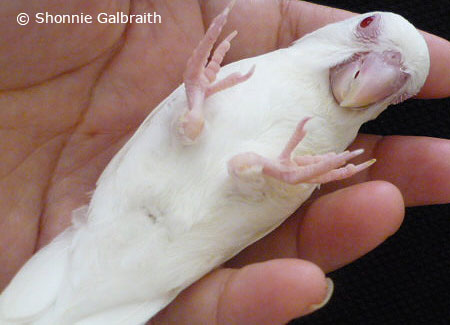
Hand feeding a baby parrotlet is a tedious job and should be done by experienced breeders only. The babies need to be fed around the clock until they fledge (are ready to leave the nest). As the babies grow their feathers out, all the babies will cut back on their feedings. This is a natural instinct as the babies are getting ready to fly. A dated method, which is still unfortunately practiced by breeders today, is to feed the babies only in the morning and the evening. It was believed that if babies remained hungry they would begin eating solid foods faster. This old-fashioned method causes an excessive amount of stress and actually takes the babies much longer to wean. It is much better to feed the babies in several small doses throughout the day.
A baby that is fed throughout the day will wean much faster. In this way it also learns not to cry and beg for food. The breeder should place fresh fruits and vegetables inside the weaning brooder at an early age to expose the chicks to new foods. To encourage weaning, try giving the babies fresh steamed pumpkin or carrots to help them convert over to solid foods. Most baby parrotlets will wean by eight weeks, although some can take as long as 10 weeks. The key is to remain patient.
Selecting the Proper Cage for Your Parrotlet
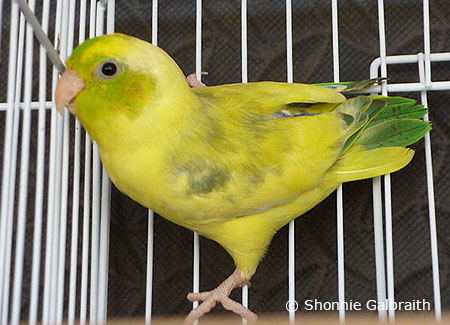
When selecting the proper cage for your parrotlet, it is important the cage be usable for the owner and the bird. The cage should be large enough to house a few toys, food and water bowls, and the perches. Because parrotlets are small, a nice sized parakeet cage, lovebird, or cockatiel cage will do.
The cage should have at least three doors. One door should hold the food bowl, the other door should hold the water bowl, and the third door should allow the owner easy access to the bird and toys.
In addition, the cage should also have a few perches that are different in size. These perches will allow a parrot to exercise its feet. Toys should be suspended from the top of the cage as these birds love to hang upside down and swing. Parrotlets are very active for their size and will spend most of their time exploring their cage. Food and water bowls should never be placed under perches as they will easily get contaminated with the bird’s droppings.
The bottom of the cage should have a grill installed. This is important because any food that has dropped will be contaminated with bacteria from the bird’s feces.
Lastly, a good cage will have a tray that can easily be removed and cleaned. This is important as the tray will contain the bird’s mess. It is important this grill be removed daily for cleaning as parrotlets are very clean animals and can easily get sick if the cage is not properly maintained.
Feeding your Parrotlet
Though parrotlets are small, they eat a lot. These birds are constantly on the move and their metabolisms are always functioning at a high level. Because of this, high calorie food items should be placed into the bowls such as sunflower seeds, safflower seeds, and millet. Additionally, a healthy pellet diet needs to be included as most provide the parrotlet with nutrients the bird needs to remain healthy.
Parrotlets enjoy a variety of fresh fruits and vegetables. Because these parrots do not manipulate their food with one hand, the owner should cut the food into smaller pieces. Daily fresh greens such a kale, spinach, dandelion leaves, or carrot tops can be given.
Fruits should be given as well. Cutting smaller piece of an apple, kiwi, mango, or pear will allow the bird to maneuver the fruit as they eat it. Many owners will get creative and make a salad that the parrots will enjoy.
If the parrotlet is fed a healthy diet and taken to the vet regularly, parrotlet owners can expect their parrots to live between 15 to 20 years.